
Dogs respond to crying. Are they sharing our sadness?




A person starts to cry. Their dog looks up, walks over and stays close. It is easy to describe that moment as empathy. But what would show that the dog is sharing the person's sadness, rather than responding to the change in their behavior?
A new study of 35 pet dogs found that dogs directed more behavior toward people acting out crying than toward people laughing or reading aloud.[1]
A separate test, however, did not detect a corresponding change in the dogs' emotional outlook.[1]
The interesting result is not that dogs care, or that they do not. It is that noticing distress, approaching someone and sharing their feelings are different things to investigate.
The research, published on October 5 in Frontiers in Ethology, was conducted by Kalyn A. Otzelberger, Teresa Romero and Julia E. Meyers-Manor, affiliated with Ripon College in Wisconsin and the University of Portsmouth in the United Kingdom.[1]
Rather than relying on a single sign of empathy, the team compared behavior, heart-rate variability, owner questionnaires, a food-bowl task and responses to yawning in the same group of dogs.[1]
What happened when people cried?
The dogs visited the Ripon College laboratory twice, approximately a week apart.[1]
In one room, an owner and an unfamiliar experimenter took turns reading aloud, then later either acting out crying or laughing, in 20-second presentations.[1]
The other emotion was presented on the second visit, and the people were instructed not to interact with the dog during the displays.[1]
Researchers recorded a combined measure of “person-oriented” behavior: looking at, approaching, touching or vocalizing toward a person.[1]
This measure was highest during crying, lower during laughter and lowest during reading.[1]
The dogs also directed more of that behavior toward the person displaying the emotion, including when that person was the stranger.[1]
That last detail matters. The observed pattern was not simply dogs turning back to their owners whenever something unusual happened. Their responses were directed toward the person crying or laughing. Calling this a response to an emotional display is supported; calling every approach an attempt to comfort goes beyond what was measured.
The food bowl question
The researchers then asked a less obvious question: after seeing a person cry, would a dog approach an uncertain opportunity differently?[1]
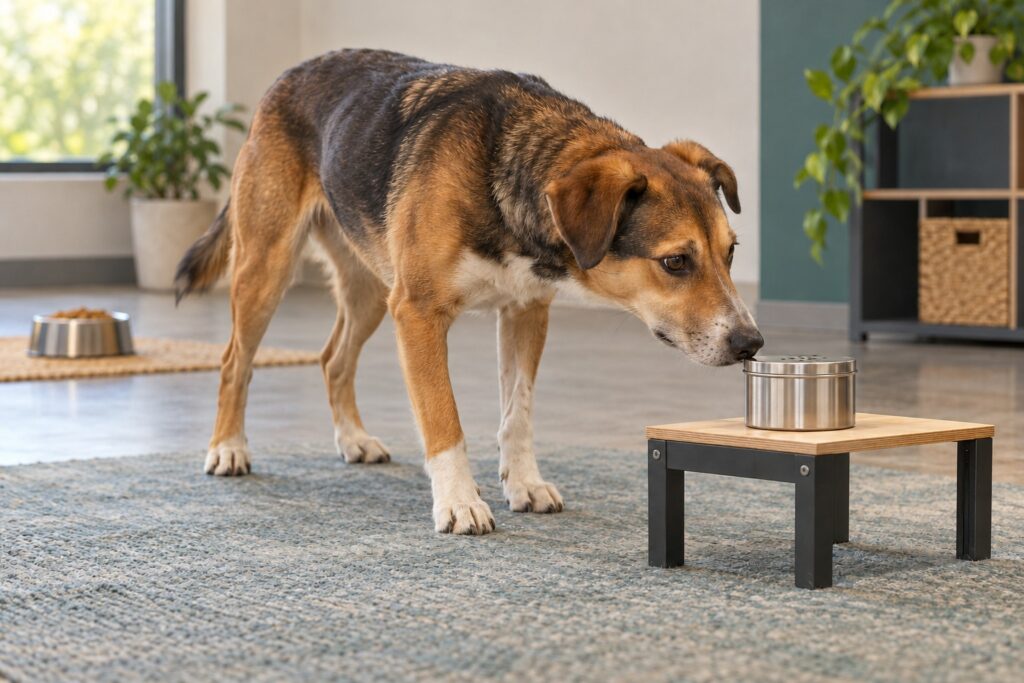
For this task, dogs learned that a bowl presented at one position contained food, while a bowl at another position did not.[1]
The researchers then introduced an empty bowl at an unfamiliar position midway between the two.[1]
A quick approach can be interpreted as a more optimistic expectation of finding food, while a slower approach can suggest a more pessimistic expectation.[1]
This is called a cognitive-bias task. It is an indirect way to investigate emotional state, not a readout of exactly what a dog feels.
Twenty-six of the 35 dogs completed the task successfully; the others were excluded from this analysis because of stress behaviors or difficulty meeting the learning criterion.[1]
Among the dogs included, there was no statistically significant difference in approach time to the middle bowl after the different human displays.[1]
That result leaves an important question open. The test did not demonstrate that the dogs became sadder after watching crying. But it also did not demonstrate that they felt nothing.
The dogs had to move to another room before taking the bowl test, so a brief emotional change could have faded during the delay.[1]
The authors also note that their single middle position might have missed subtle effects that other ambiguous positions could reveal.[1]
Those are possible explanations for the result, not established proof that a hidden effect occurred.
What heart monitors and owners added
The heart-monitor results were also more complicated than “crying made the dogs stressed.” Heart-rate variability, a measure of variation in the intervals between beats, did not differ significantly overall across the human-display conditions.[1]
Within particular conditions, dogs showing more person-oriented behavior had lower variability when the stranger cried and when their owner laughed.[1]
The researchers discuss this as potentially consistent with contact-seeking during mild stress, but substantial missing monitor data and the correlational findings limit that interpretation.[1]
It does not identify sadness in the dog.
Owners' reports added a different kind of information. Dogs rated as more responsive to their owners' emotions also showed more person-oriented behavior when their own owners cried.[1]
Those ratings were not significantly associated with responses to a crying stranger.[1]
That supports the value of owners' observations about their own relationships, without turning a questionnaire into a universal empathy score.
A yawning test contributed little to the comparison: only four dogs yawned in response to the experimenter's yawns, so the researchers did not pursue further analyses of that measure.[1]
What owners and trainers can take from it
The study's useful contribution is to separate an observable response from an explanation for it. “My dog came closer when I cried” describes something that happened. “My dog felt my sadness and came to make me feel better” adds claims about emotional experience and intention.
This experiment supports the first kind of description and leaves the second unresolved. It involved a small volunteer sample and acted emotions in a laboratory, not naturally occurring moments of distress at home.[1]
For anyone observing a dog, useful questions are concrete: What changed in the person's voice or posture? Did the dog look, approach, make contact or move away? What happened next? Those observations can be worth recording without using them to grade how much a dog loves someone.
Nor does the result make pretending to cry a validated home empathy test. A response, or a lack of one, is not a verdict on the relationship.
These dogs responded differently to human emotional displays, especially crying.[1]
Understanding what they experienced themselves will require more than watching them come closer.
Read the study
[1] Otzelberger, K. A., Romero, T., and Meyers-Manor, J. E. (2026). Let’s get it together: the relationship between different measures of empathy in dogs. Frontiers in Ethology, 5:1944284. Original abstract and complete study PDF in our Knowledge Base. Original publisher version.




Responses