
Breakfast reduced false alerts in a small scent-detection study

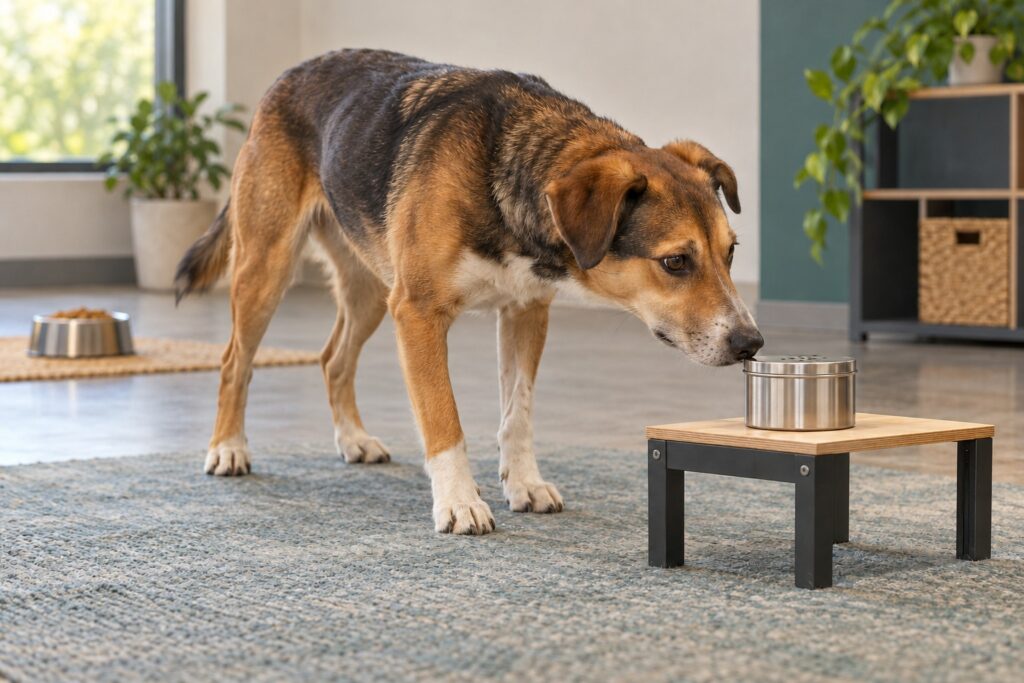


Dogs trained to distinguish a target odor from other smells made fewer false alerts after their normal breakfast in a small laboratory experiment.[1] A companion analysis of the same six dogs found generally low levels of frustration-related behavior, although some dogs whined more when breakfast was delayed.[2] Together, the papers examine how feeding conditions can affect both detection performance and behavior during a food-rewarded task.[1][2]
The performance paper, by Journie Yee, Iwan Downie, Jade Fountain and Timothy L. Edwards, appeared in Learning and Motivation.[1] The companion paper, led by Fountain, appeared online in Behavioural Processes.[2] The University of Waikato publicized the research in September 2026.[3] These are two analyses of one experiment, not two independent replications.[1][2]
The difference was in rejecting the wrong smell
The dogs' average hit rate, meaning correctly indicating when the target was present, stayed near 90% with and without breakfast.[1] The clearer difference appeared on trials containing a non-target odor: dogs were more likely to reject it correctly after eating.[1]
That breakfast effect on correct rejection was statistically significant in the researchers' model (p = .016).[1] Five of the six dogs showed better rejection rates after breakfast; the remaining dog performed similarly in both conditions.[1] Breakfast did not produce a statistically significant change in hit rate.[1]
A dog that finds most targets can still make mistakes by indicating on other smells.[1] The distinction matters when assessing accuracy: counting successful finds alone would not reveal the feeding-related difference observed in this experiment.[1]
How the experiment worked
The researchers recruited pet dogs from the Waikato community and trained them to use an automated odor-delivery apparatus.[1] Six dogs took part in the experiment after a seventh was excluded during initial training because it was averse to the automatic feeder.[1] Each dog experienced both breakfast conditions, with the order randomized within weeks.[1]
On breakfast days, the dogs received their usual morning meal at approximately 9 a.m., before testing.[1][2] On the other days, breakfast was delayed until approximately 11:50 a.m., after the morning sessions.[1][2] Testing took place within the same daily time window in both conditions.[1][2] This was a comparison of meal timing, not a starvation experiment.[1][2]
The target was a fixed mixture of four odors.[1] The dogs indicated a target by keeping their nose in a sampling port for a set duration.[1] To reject a sample, they briefly sampled it and operated a lever to move to the next trial.[1] As dogs advanced, the researchers increased the overlap between target and non-target mixtures to keep the discrimination task challenging.[1]
Correct target indications triggered a food dispenser.[1][2] Correct rejections did not directly earn food, although they allowed the dog to move on.[1][2] Dogs in the no-breakfast condition therefore still received food rewards during testing.[1][2] Once trained, the dogs could operate the apparatus without a handler directing each response.[1][2]
Hunger, reward value and discrimination
The researchers considered whether a recent meal might help performance through changes in cognition, motivation, or both.[1] One proposed explanation is that hunger makes food a more powerful reinforcer, encouraging the dog to respond to a broader range of smells resembling the target.[1]
The authors discuss this in terms of motivating operations: conditions that change how effective a particular reward is as a reinforcer and influence behavior that has earned it.[1] An establishing operation increases that reinforcing effectiveness; an abolishing operation reduces it.[1] In their account, time without food can act as an establishing operation for food, while a recent meal can act as an abolishing operation.[1] “Abolishing” does not have to mean eliminating all interest in food; the relevant change is a reduction in its reinforcing effectiveness.[1] Applied here, the question is whether making food more valuable also changes how selectively a dog responds.[1] The experiment gives a reason to investigate that possibility, but it does not establish the mechanism.[1]
The researchers' formal measure of response bias, the tendency to indicate regardless of whether the target was present, did not show a statistically significant breakfast effect.[1] Neither did their separate measure of discrimination sensitivity.[1] The finding of fewer false alerts after breakfast is therefore better supported than a definitive claim about whether hunger changed the dog's decision pattern or sensory ability.[1] A nonsignificant result does not prove that those abilities were identical.[1]
The companion paper examined behavior
Fountain and colleagues analyzed video recorded during the same experiment, rather than testing a new group of dogs.[2] They coded behavior such as whining, interaction with the food dispenser, pawing at the apparatus, and body posture.[2]
The authors reported more frequent whining before breakfast, with the pattern particularly apparent in two dogs.[2] Most frustration-related behaviors were uncommon, and individual dogs differed substantially.[2] Some behaviors also varied with time of day and over the course of the study.[2]
These observations do not establish that working before breakfast caused widespread distress.[2] Nor does a quiet dog necessarily reveal everything about its internal state.[2] The companion paper assessed observable behavior, and its authors identified physiological measures as a useful addition to future research.[2]
What food-reward trainers can take from the findings
For trainers who use food as a reward, the practical relevance is that meal timing was associated with the quality of responding, not simply whether the dogs would detect targets.[1] In this experiment, delaying breakfast did not clearly improve target detection and was associated with more false alerts.[1] That challenges the assumption that making a dog hungrier must improve every part of a food-rewarded task.[1]
A useful training question is whether the management plan supports accurate, willing work, rather than simply making the dog more eager to obtain the reward. The aim need not be maximum hunger or complete satiation. It can be enough motivation for the task without sacrificing the dog's welfare or overlooking mistakes.
This is the balance worth considering when thinking about establishing and abolishing operations. Reducing a reward's value is not automatically a training failure, just as increasing it is not automatically a training improvement. In this study, the dogs still detected targets at a high rate after breakfast, while making fewer false alerts.[1] The papers do not, however, establish that frustration caused those false alerts, or identify a universal “sweet spot” between too little and too much motivation.[1][2]
Could the same question apply to a ball or tug?
The performance paper's authors explicitly identify play and preferred toys as rewards used by handlers, and call for research on feeding effects in those other training contexts.[1] This experiment used food rewards; it did not test whether prior access to a ball, tug or play session changes accuracy.[1][2]
For a trainer using play, an analogous question is worth asking: if a dog has not had an opportunity to play yet, does the chance to chase a ball or tug become more valuable, and does that change the quality of its work? Could some play before training preserve enthusiasm while improving precision, or would it reduce interest in the reward? If performance changes after play, is reward value the explanation, or could tiredness, the warm-up or something else account for it?
Those are hypotheses to examine, not findings from these papers. Having had no play yet is not an established equivalent of the no-breakfast condition, and the research does not show that withholding play produces the same false-alert pattern.
Questions for a dog's training and management plan
The following are prompts for reflection and record-keeping, not a feeding or play protocol tested by the researchers:
- What food, play, rest and other activity has this dog had before the session, and have I recorded it consistently?
- Am I tracking correct responses and mistakes, including false alerts or responses before the appropriate cue, rather than judging motivation only by speed or enthusiasm?
- When the dog becomes more focused on obtaining a reward, does its accuracy improve, stay the same or decline?
- If whining, repeated unsuccessful attempts or disengagement appear, have I considered task difficulty, unclear criteria, delayed rewards or fatigue rather than assuming the dog needs to be hungrier or have less access to play?
- Could a change in session length, reward delivery or pre-session routine support both engagement and accuracy without increasing deprivation?
Keep appropriate nutrition, rest and enrichment in place when reviewing these questions. Observe the individual dog across comparable sessions, rather than treating a single energetic or quiet performance as proof of an ideal motivational state. The goal is a workable balance between engagement, accuracy and welfare, not stronger reward-seeking at any cost.
There are limits to carrying these findings into daily practice.[1][2] The sample consisted of six selected community dogs working with a laboratory apparatus, not operational search teams.[1][2] The researchers used each dog's usual breakfast rather than a standardized diet, and dogs accumulated food rewards during testing.[1][2] The study did not establish an optimal meal size or feeding interval.[1][2] The researchers also caution against interpreting the findings as a recommendation to give every working dog a large meal immediately before a job.[3] The demands of the work and the individual dog still matter.[3]
The sources below link to both complete papers. The companion behavior paper is also available as a free, unchanged PDF in our Knowledge Base. Readers can examine the methods, results and limitations themselves.
Sources and full papers
[1] Yee, J., Downie, I., Fountain, J., and Edwards, T. L. (2026). The breakfast effect revisited: Dogs’ scent detection performance before and after a meal. Learning and Motivation, 95, 102328. DOI: 10.1016/j.lmot.2026.102328. Full publisher text, CC BY 4.0.
[2] Fountain, J., Yee, J., Hazel, S. J., McWhorter, T. J., McNutt, T., and Edwards, T. L. (2026). Effects of feeding on dogs’ frustration-related behaviours during a laboratory-based scent detection task. Behavioural Processes, 242, 105430. Available online August 29, 2026; assigned to the November 2026 issue. DOI: 10.1016/j.beproc.2026.105430. Our Knowledge Base includes the original abstract, unchanged CC BY 4.0 publisher PDF and publisher link.
[3] University of Waikato (September 11, 2026). Hungry scent detection dogs more likely to “cry wolf”.




Responses