
What Captive Wolves Do After Aggression, and Why Trainers Should Watch Closely

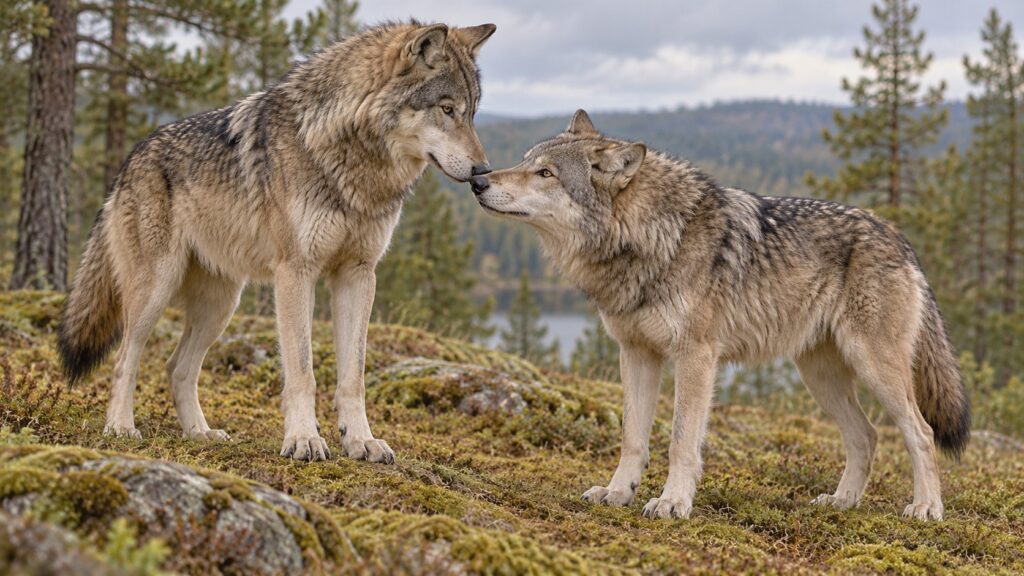


Researchers compared the minutes after naturally occurring aggression in five captive wolf groups with matched calm periods. Their attention to timing, partners and initiation gives trainers a sharper framework for observing social interaction.
When dogs that live together have an aggressive interaction, the minutes that follow can be as informative as the interaction itself. Do the former opponents approach each other, keep apart or turn to another animal? Who initiates any contact, and how quickly? A new study of captive wolves offers trainers a disciplined way to ask those questions, even though it did not study dogs.
The paper, Differences in post-conflict behaviour in wolves and dog-admixed wolves, by Federica Amici, Paolo Ciucci and seven colleagues, was published online in Royal Society Open Science on 21 October 2026.[1]
It compared affiliative behavior after naturally occurring aggression with the same animals' behavior at matched calm moments.[1]
Its results describe captive wolves. What carries over to dog training is the observational logic, not a set of expected rates.
Roles and behaviors
The paper calls the animal that directed aggression, such as a bite, chase or lunge, the aggressor, and the animal that received it the victim.[1]
These are roles within a single interaction, called initiator and recipient here, and several wolves occupied both roles in different conflicts.[1]
Affiliative behavior was coded as body contact, social play, licking and sniffing.[1]
The authors define reconciliation as affiliative interaction between former opponents shortly after a conflict, and third-party affiliation as affiliative interaction between the recipient and another group member. Contact counted as solicited if the recipient initiated it and unsolicited if it did not.[1]
Reconciliation has been proposed to repair relationships or reduce stress after conflict.[1]
In this study, it names a timed behavioral pattern.[1]
Its function was not measured.[1]
Five captive groups
The researchers observed 20 adult wolves without known dog ancestry in two German facilities and 13 adult dog-admixed wolves in three Italian facilities.[1]
The admixed animals were genetically confirmed second- or later-generation backcrosses to wolves, wild-born and removed from the wild during conservation management.[1]
They are wolves with some dog ancestry, not domestic dogs.[1]
Observations between 2023 and 2025 took place under standard visitor conditions without experimental intervention, and the authors report that none of the 135 recorded conflicts caused injury.[1]
These were captive assemblies, some formed from littermates kept together into adulthood and some from adults introduced later.[1]
In L. David Mech's field work, the typical free-living pack is a family of a breeding pair and their recent offspring, most of whom disperse within a few years.[3]
Comparing conflict with calm
After each aggressive interaction, observers recorded the two former opponents for two minutes.[1]
They recorded the same pair again for two minutes on the next possible day within a week, at the same time of day, when both were awake, visible, within about 10 meters of each other and free of aggression for the previous 15 minutes.[1]
A conflict met the study's criterion if the first affiliative behavior involving the recipient occurred only in the post-conflict window, or earlier there than in the control.[1]
Pooled across the five groups, 70 of 135 conflicts met that criterion.[2]
That is a count of conflicts, not of animals or groups, and it does not mean every wolf or every group showed the pattern.[1][2]
A conflict that missed the criterion was not necessarily followed by no affiliation.[1]
Any contact simply did not come earlier than in the control.[1]
Who initiated contact
The authors report that recipients solicited most reconciliation and third-party affiliation events, though several unsolicited interactions also occurred.[1]
The deposited conflict data do not include solicitation records, so this point rests on the authors' report.[2]
The authors argue that because recipients usually sought the third-party contact, there is little room to interpret those interactions as consolation, and they call for more data on unsolicited contact to assess possible functional differences.[1]
Initiation shows who approached. It does not show whether a contact reduced stress for either animal.
Aggression with physical contact
Aggression was classed as high intensity if it involved physical contact and low intensity if it did not, a distinction about contact rather than harm.[1]
In the deposited data, 51 of 85 contact conflicts met the criterion, compared with 19 of 50 without contact. These are unadjusted counts in which the same animals recur.[2]
The authors' model, which accounts for repeated recipients and initiators, reports that the criterion was more likely to be met after contact conflicts in both admixed and non-admixed wolves. They suggest greater risk, stress or relationship uncertainty as possible reasons, none of which the study measured.[1]
Dog ancestry
The authors predicted less post-conflict affiliation in admixed wolves and found no evidence of that.[1]
With only five groups, that null result does not show that the two behave alike.
Ancestry also coincided with country, facility, group size and composition, early experience and reproductive procedures, which the authors could not control.[1]
For trainers: questions worth asking
In these captive groups, aggression and subsequent affiliation were both part of the observed social repertoire.[1]
That describes this setting. It is not a species-wide frequency, and it is not a standard for what a managed group or a household should accept.
Adapted to dogs that live together, the study's design suggests five questions:
- Sequence. What preceded the interaction, what form did it take, and what did each dog do immediately afterward?
- Partner and initiator. Did affiliative contact involve the former opponent or another animal, and which dog approached?
- Latency. How soon after the interaction did that contact occur?
- Recipient's response. Did the dog receiving contact reciprocate, tolerate it or move away? The wolf study did not analyze this, but it can be observed.
- Baseline. How does the pair usually interact at a similar time and place without conflict?
Baseline is the study's central lesson. A lick or sniff after aggression means little until it is compared with how often the same pair licks or sniffs at comparable calm moments.
A single episode is similarly limited. It records what each animal did in one sequence, but not the pair's usual rates of affiliation, avoidance or aggression, which only repeated observation across contexts can establish.
These questions apply to interactions that happen on their own. Provoking conflict, delaying intervention or pushing animals back into contact to see what follows would put animals and people at risk and has no basis in this study.
How far it carries to household dogs
The authors' literature review notes that earlier studies reported reconciliation in domestic dogs, though not uniformly, and that evidence for third-party affiliation in dogs is inconsistent.[1]
This study did not include household dogs.[1]
Shared, bounded space with fixed companions makes captive groups a useful point of comparison for multi-dog homes, not an equivalent in ecology or social organization.
The researchers described each wolf group's composition, history and enclosure, but the study did not examine how such conditions shape post-conflict behavior in dogs.[1]
For any given household, its composition, the dogs' history together, room to avoid one another and human management remain open questions about transferability, not measured effects.
Reporting note
Methodological note: The paper's reported share of wolves with positive individual post-conflict tendencies disagrees with the authors' deposited individual-level table.[1][4]
The paper also gives conflicting statements about which wolves showed post-conflict body contact, and its solicitation denominators are not fully consistent.[1]
This article therefore relies on conflict-level counts checked against the deposited data and on the authors' qualitative reports, and it omits exact solicitation percentages and the paper's ancestry-specific rank and bond models.[1][2]
DogTraining.World did not independently refit the authors' statistical models.
Sources
[1] Differences in post-conflict behaviour in wolves and dog-admixed wolves
[2] Conflict-level supplementary data

Responses