

Resource type: Original research — surgical follow-up study
Publication
Alberto Crovace; Francesco Staffieri; Donato Monopoli; Alejandro Artiles; Laura Fracassi; Antonio Crovace; Luca Lacitignola (2020). Role of Tibial Tuberosity Fracture/Fissure through the Maquet Hole in Stifle Osteoarthritis after Porous Tibial Tuberosity Advancement in Dogs at Mid-Term Follow-Up. Veterinary Sciences, 7(1), article 1. DOI: 10.3390/vetsci7010001
Published online: 22 December 2019.
Issue citation: Veterinary Sciences 7(1), article 1 (2020). The online date is 22 December 2019.
Reading note: This study compared 17 cases. A statistically non-significant group difference is not proof that a complication is harmless in every patient.
Author abstract
The following is the authors’ abstract, not a site-written summary. Wording is retained; paragraph structure and inline typography are formatted for this page.
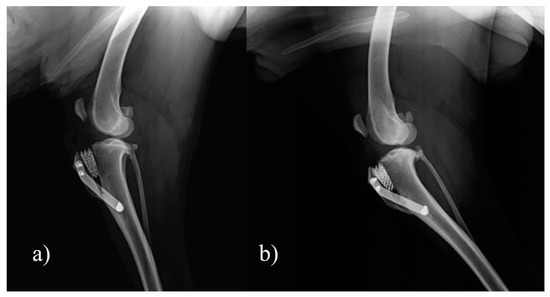
Tibial tuberosity advancement (TTA) is used to treat cranial cruciate ligament rupture of the stifle joint in dogs. Tibial tuberosity fracture/fissure is a complication of TTA that may have a favorable prognosis. The aim of this study was to detect how tibial tuberosity fracture/fissure through the Maquet hole worsens the progression of osteoarthritis (OA) in the stifle joint of dogs treated with porous TTA. Seventeen cases were included in the study, divided into two groups. The first group (n = 10) included subjects that had tibial tuberosity fracture/fissure through the Maquet, and the second group included subjects that had no complications (n = 7). Both groups showed significant progression compared to OA at 3 months after surgery. We observed that at T0, the control group showed a higher level of OA. For this reason, we normalized the OA scores, evaluating the percentage difference from T0 and T1. We verified that there were no statistically significant differences between the two groups. The results confirm that OA progression in subjects undergoing TTA was not significantly influenced by fracture/fissure of the tibial tuberosity through the Maquet hole. Therefore, fracture fissure through the Maquet hole should be considered as a common minor complication during TTA.
Source and attribution
© 2019 by the authors. Reused under Creative Commons Attribution 4.0 (CC BY 4.0). The researchers named above are the publication authors; this site provides the resource presentation.
Read the original publication · Read the repository copy (Europe PMC)
Presentation changes: bibliographic and resource-type labels added; import formatting cleaned. Author-abstract wording is preserved. Existing images, source URLs and attachments are retained; separately credited material remains subject to its own terms.
Existing publication image