
OnkoDog will test whether dogs can detect cancer in urine

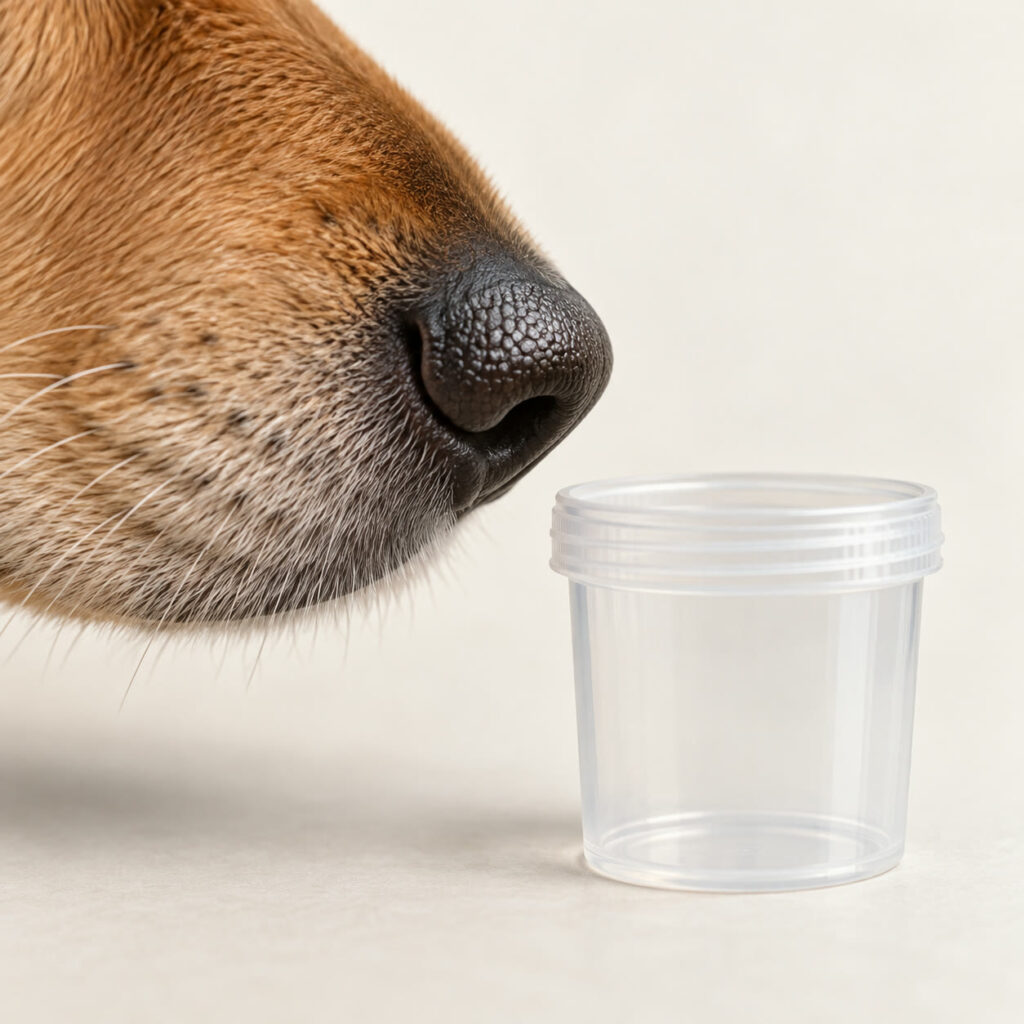


A new German research project will test whether trained dogs can identify prostate, bladder and kidney cancers from urine samples. Announced by the University of Veterinary Medicine Hannover (TiHo) on October 8, 2026, OnkoDog is a two-year project that will use blinded tests to assess the dogs' reliability.[1]
The announcement describes research getting underway, not a proven cancer-screening service. Its proposed role is to flag samples for further medical investigation, not replace a doctor's diagnosis.[1]
Read TiHo’s original project announcement (German).
What the OnkoDog team plans to investigate
According to TiHo, the project has received €290,000 in funding from NBank. The university is working with detection-dog training company AWiAS Aviation Services GmbH and software developer Sindojan Automotive. Sebastian Meller and Professor Holger Volk are part of the TiHo team.[1]
Researchers plan to train medical detection dogs to recognize odor patterns associated with the three cancers in urine samples. Alongside the dog work, the team will examine the samples' odor profiles in the laboratory to investigate which chemical patterns might be involved.[1]
TiHo describes the underlying idea as detecting changes in volatile organic compounds associated with altered metabolism. That is the biological basis the project is exploring; it does not establish how accurately these dogs will distinguish cancer from other conditions.[1]
AWiAS also describes the collaboration on its own project page, where it uses the name OnkoDog2 and identifies prostate-cancer detection as a focus. This is another account from a project participant, rather than an independent assessment of the method.[2]
Why blinded testing matters
For dog trainers, the testing procedure deserves as much attention as the training itself. A dog responding to familiar training samples is a different proposition from a detection team reliably assessing samples whose status is unknown to the people conducting the test.
Research in other detection settings shows why human knowledge needs attention. In a 2011 study of drug and explosive detection teams, researchers manipulated handlers' expectations while placing no target odor in the search areas. Those expectations affected where handlers reported alerts. The study examined false alerts under those conditions; it did not test cancer detection or establish that trained dogs could not find their target odors.[5]
The relationship is not as simple as saying that handler knowledge always makes a team less accurate. A separate 2020 study found changes in search behavior but no difference in overall accuracy between its single-blind and double-blind test conditions.[6]
TiHo says OnkoDog will use blinded tests, but its launch announcement does not provide the full testing protocol. It would therefore be premature to describe the project as double-blind or assign it a diagnostic accuracy rate.[1]
A planned workplace trial
The project also aims to explore whether urine-sample testing could be used in workplace health programs. TiHo says the approach will be tried in a business under real-world conditions, supported by software intended to anonymize samples and organize findings by work area.[1]
That is a planned application to investigate, not an established employee screening program. The university explicitly states that a dog's indication should not replace medical diagnosis.[1]
What to look for when results arrive
The launch announcement does not report OnkoDog's sensitivity, specificity, or performance on a completed set of test samples.[1] Those details will matter more than a headline saying that dogs can smell cancer.
When results become available, useful questions will include:
- Were the test samples from people whose samples the dogs had never encountered during training?
- Who knew each sample's status, and how was that information kept from influencing the test?
- How often did the dogs miss a cancer sample, and how often did they indicate a sample without cancer?
- Could the dogs distinguish the cancers from other urinary or medical conditions?
- Did performance remain consistent across dogs and in the proposed workplace setting?
These are questions for evaluating future findings, not claims that the project has already answered them. A short announcement cannot resolve whether a method is ready for clinical use.
For now, OnkoDog is a project to follow for its approach to training and validation. The outcome worth watching is whether the teams can produce reliable results under controlled testing, and whether those results hold up outside training. It is not a reason to change medical screening or diagnostic decisions.
Sources
- University of Veterinary Medicine Hannover, “Projekt OnkoDog startet,” October 8, 2026 (German).
- AWiAS Aviation Services, OnkoDog2 project page (German).
- Lit, Schweitzer and Oberbauer (2011), “Handler beliefs affect scent detection dog outcomes,” Animal Cognition.
- “Effect of Handler Knowledge of the Detection Task on Canine Search Behavior and Performance” (2020), Frontiers in Veterinary Science.



Responses