

Resource type: Original research — randomized pilot clinical study
Publication
Cristina Di Palma; Fabiana Micieli; Barbara Lamagna; Annalisa Nieddu; Valeria Uccello; Gerardo Fatone; Giancarlo Vesce (2020). Schirmer Tear Test Value and Corneal Lesions’ Incidence during General Anesthesia for Non-Ophthalmic Surgery in Non-Brachycephalic Dogs: A Pilot Study Comparing Three Different Lubricant Eye Drop Formulations. Veterinary Sciences, 7(1), article 25. DOI: 10.3390/vetsci7010025
Published online: 18 February 2020.
Reading note: This pilot involved twenty-five non-brachycephalic dogs undergoing general anaesthesia. Its results concern the tested formulations and study setting, not universal prevention of corneal injury.
Author abstract
The following is the authors’ abstract, not a site-written summary. Wording is retained; paragraph structure and inline typography are formatted for this page.
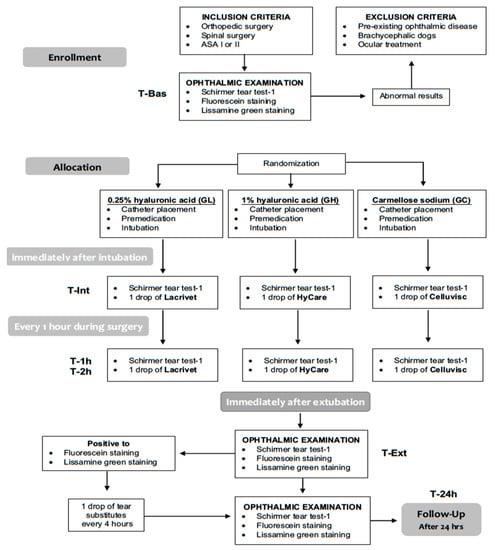
Aim of this blinded, prospective, randomized clinical study was to compare three different lubricant eye drops (LED) in healthy adult dogs undergoing general anaesthesia (GA) for non-ophthalmic surgery. Tear production rate was monitored by means of Schirmer tear test-1 (STT-1), and incidence of post-operative corneal abrasions/ulcerations was detected by corneal staining. A complete ophthalmic examination was performed before premedication, at extubation time and 24 h after GA in twenty-five non-brachycephalic dogs (fifty eyes) undergoing elective orthopaedic or spinal surgery procedures. Dogs were randomly allocated to one of three groups receiving as prophylactic LED either carmellose sodium (GC), or 1% hyaluronic acid (GH), or 0.25% hyaluronic acid (GL). In each eye STT-1 was repeated every hour during GA, before instilling one drop of the assigned LED. In all groups STT-1 values drastically decreased during GA, while 24 h later nine eyes (18%) had STT-1 values lower than 15 mm/minute. All of the three formulations tested were fully effective in preventing corneal ulceration (0% in all groups), while 10% of eyes reported superficial de-epithelialization. Fluorescein staining demonstrated that hourly prophylactic LED application prevented exposure keratopathy during general anesthesia in 90% of the eyes in non-brachycephalic dogs.
Source and attribution
© 2020 by the authors. Reused under Creative Commons Attribution 4.0 (CC BY 4.0). The researchers named above are the publication authors; this site provides the resource presentation.
Read the original publication · Read the repository copy (Europe PMC)
Presentation changes: bibliographic and resource-type labels added; import formatting cleaned. Author-abstract wording is preserved. Existing images, source URLs and attachments are retained; separately credited material remains subject to its own terms.
Existing publication image